


Reincarnation conceptualizes the soul's journey through successive lives, governed by the moral repercussions of past actions, encapsulated within the doctrine of karma. This cyclic transcendence allows for spiritual evolution, aiming at ultimate enlightenment. Across cultures, this belief transforms emotional landscapes and frames life as a coherent narrative of spiritual maturity. Techniques like past life regression and guided meditation provide insights into one's past lifetimes, inviting a deeper understanding of one's current life and its challenges. Further exploration can lead to profound personal revelations.
Key Takeaways
- Reincarnation is the belief that the soul undergoes multiple lifecycles, evolving spiritually with each new birth based on past actions.
- Karma plays a crucial role, as it dictates the soul's journey and circumstances of each reincarnation, aiming for balance and moral rectification.
- Techniques like past life regression and guided meditation can help individuals access memories of previous lives, promoting understanding and spiritual growth.
- Cultural perspectives on reincarnation vary, offering a rich tapestry of beliefs about the soul's journey and the afterlife.
- Understanding reincarnation can provide a deeper sense of purpose and encourage ethical living, as each life contributes to the soul's evolutionary path.
Understanding the Basics of Reincarnation

Why do some cultures believe in reincarnation?
The concept of reincarnation centers on the belief that the soul undergoes a series of life cycles, each entry into a new body dictated by past actions and moral integrity.
This soul journey is perceived as an opportunity for spiritual evolution, allowing the soul to rectify past misdeeds and evolve towards a higher state of consciousness.
Cultures supporting this view see life as a continuum, an unending cycle of birth, death, and rebirth, aimed at achieving ultimate enlightenment or liberation.
This belief underscores a metaphysical framework where the soul's progression is paramount.
Historical Perspectives on Reincarnation Across Cultures
Throughout history, the belief in reincarnation has manifested in diverse forms across various cultures, illustrating a multifaceted understanding of life and the afterlife. This belief, deeply rooted in ancient beliefs, reveals significant cultural variations. For instance, in Hinduism, it is closely linked with karma and the cycle of birth, death, and rebirth, whereas in ancient Greek philosophy, it was explored by Pythagoras and Plato as metempsychosis. The table below captures the emotional landscape across different cultures regarding reincarnation:
| Culture | Emotion | Belief Detail |
|---|---|---|
| Hindu | Spiritual hope | Cycle of Samsara |
| Greek | Philosophical | Metempsychosis |
| Native American | Ancestral pride | Rebirth of souls |
| Buddhist | Contemplative | Escape from the cycle |
| Australian Aboriginal | Cultural identity | Dreamtime reincarnation |
These historical perspectives enrich our understanding of human belief systems about life's continuation beyond death.
Reincarnation and Its Significance in Modern Spirituality

In modern spirituality, reincarnation emerges as a pivotal concept that bridges past wisdom with contemporary existential inquiries.
It frames the soul journey as a continuum, advancing through various lifetimes towards spiritual evolution. This perspective fosters a deeper understanding of life's purpose as not merely a series of isolated events but as a cohesive narrative aimed at spiritual maturity and enlightenment.
By accepting reincarnation, individuals embrace the possibility of growth beyond a single lifespan, viewing each life as a chapter in a grander, soulful narrative.
This belief system profoundly influences personal development, ethical behaviors, and holistic wellness within modern spiritual contexts.
The Role of Karma in Reincarnation
Building on the concept of reincarnation as a cornerstone of modern spirituality, karma emerges as a fundamental principle that orchestrates the cycle of rebirth.
Karma cycles dictate the circumstances into which a soul is reborn, influenced by the actions and ethical decisions made in past lives. This mechanism guarantees that karmic lessons are imparted through experiences designed to spiritually evolve the soul.
Each life provides an opportunity to address unresolved issues and to ameliorate past misdeeds. Consequently, karma not only serves as a cosmic justice system but also as a pedagogical tool, facilitating the soul's progress towards enlightenment and eventual liberation.
Techniques for Discovering Past Lives
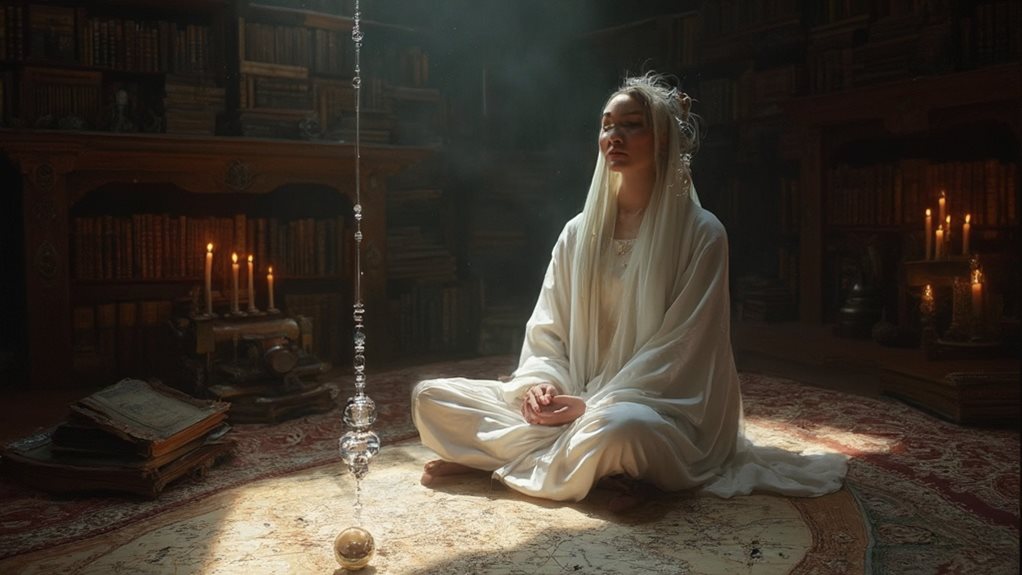
Exploring past lives has become a sought-after practice for those seeking insight into their personal and spiritual history. Techniques like past life regression and guided meditation serve as tools to reveal these mysteries. Here's a comparison of both techniques:
| Technique | Methodology | Expected Outcomes |
|---|---|---|
| Past Life Regression | Hypnotic induction to access memories | Recollection of past identities |
| Guided Meditation | Structured reflection under calm supervision | Insights into past life patterns |
| Combined Approach | Integration of both techniques | Thorough spiritual insights |
These methods provide structured pathways for individuals to explore their reincarnated pasts, potentially leading to profound personal revelations and spiritual growth.
Frequently Asked Questions
How Can Reincarnation Influence Current Relationships and Interactions?
Reincarnation may influence current relationships by fostering deep soul connections and presenting karmic lessons that individuals must navigate, potentially leading to growth and resolution of past conflicts within an analytical and scholarly perspective.
Are There Scientific Studies Validating Experiences of Reincarnation?
There are limited scientific studies providing empirical evidence for reincarnation, largely due to its metaphysical nature. Cultural perspectives influence research focus, with more interest seen in societies where reincarnation is a prevalent belief.
How Do Children Often Express Memories of Past Lives?
Children often convey past life recollections through spontaneous stories, revealing details unlikely known through their current childhood experiences. These memories manifest in persistent, precise narratives that align with historical events or unfamiliar cultural practices.
Can Reincarnation Beliefs Impact Mental Health Positively or Negatively?
Reincarnation beliefs can influence mental wellness. Positively, they may offer comfort and promote spiritual growth, fostering resilience. Negatively, they might induce stress or guilt over perceived past life actions, impacting psychological health adversely.
What Ethical Dilemmas Arise From Believing in Reincarnation?
The ethical dilemmas arising from belief in reincarnation involve moral implications and diverse cultural perspectives, questioning justice in unseen dimensions and responsibilities towards actions influenced by perceived past life experiences.
Conclusion
To summarize, the doctrine of reincarnation offers a compelling framework for understanding the continuity of the soul. A fascinating statistic reveals that approximately 24% of Americans now believe in reincarnation, reflecting its growing acceptance beyond traditional Eastern spiritual contexts. This shift underscores a broader cultural openness to concepts that challenge linear perceptions of life and death, suggesting a profound evolution in the collective spiritual and philosophical landscape of the modern world.